
After I recently upgraded a Debian machine from 12 (Bookworm) to 13 (Trixie), a couple of automated scripts stopped running. The distribution upgrade also upgraded the mariadb-client package to version 11.8 - and a new default seems to be active.
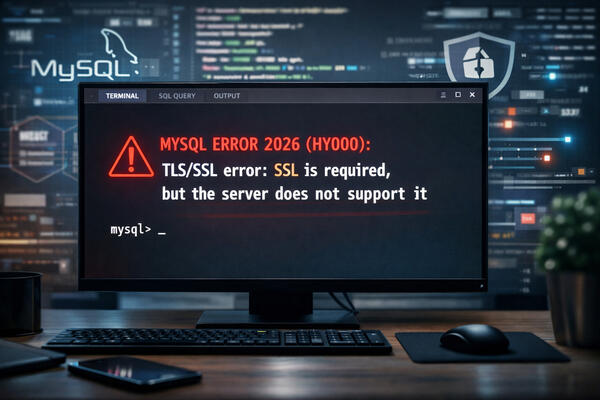
The Bash script in question uses the mysql command to retrieve some data from a MariaDB database. A manual run on the command line query quickly showed the error:
ck@trixie:~$ source .config/dbconfig.env
ck@trixie:~$ QUERY="SELECT id FROM db.table WHERE status='something';"
ck@trixie:~$ mysql -u ${MYSQL_USER} --batch --skip-column-names -e "$QUERY"
ERROR 2026 (HY000): TLS/SSL error: SSL is required, but the server does not support it
This has definitely worked prior to the distribution upgrade. A quick look into mysql --help shows what has changed:
ck@trixie:~$ mysql --help
mysql from 11.8.3-MariaDB, client 15.2 for debian-linux-gnu (x86_64) using EditLine wrapper
Copyright (c) 2000, 2018, Oracle, MariaDB Corporation Ab and others.
Usage: mysql [OPTIONS] [database]
[...]
--ssl Enable SSL for connection (automatically enabled with other flags).
(Defaults to on; use --skip-ssl to disable.)
[...]
The --ssl option is now used by default when using the mysql cli.
As the --help output shows, one fix is to use --skip-ssl option. This seems to work and the query returns the result of the query:
ck@trixie:~$ mysql --skip-ssl -u ${MYSQL_USER} --batch --skip-column-names -e "$QUERY"
2994
But instead of changing the Bash script and append each mysql command, the skip-ssl option can also be defined in a config (cnf) file:
ck@trixie:~$ cat ~/.my.cnf
[client]
skip-ssl = true
Note: It's important to define ~/.my.cnf configuration file under the $HOME directory of the user which executes the script.
This way, the ~/.my.cnf is read at the beginning of launching the mysql command and the configuration options are respected by the cli command. It's therefore not needed to add --skip-ssl in the command itself:
ck@trixie:~$ mysql -u ${MYSQL_USER} --batch --skip-column-names -e "$QUERY"
2
No comments yet.

AI AWS Android Ansible Apache Apple Atlassian BSD Backup Bash Bluecoat CMS Chef Cloud Coding Consul Containers CouchDB DB DNS Databases Docker ELK Elasticsearch Filebeat FreeBSD Galera Git GlusterFS Grafana Graphics HAProxy HTML Hacks Hardware Icinga Influx Internet Java KVM Kibana Kodi Kubernetes LVM LXC Linux Logstash Mac Macintosh Mail MariaDB Minio MongoDB Monitoring Multimedia MySQL NFS Nagios Network Nginx OSSEC OTRS Observability Office OpenSearch PHP Perl Personal PostgreSQL PowerDNS Proxmox Proxy Python Rancher Rant Redis Roundcube SSL Samba Seafile Security Shell SmartOS Solaris Surveillance Systemd TLS Tomcat Ubuntu Unix VMware Varnish Virtualization Windows Wireless Wordpress Wyse ZFS Znuny Zoneminder